Merl S. Why the Soviet Union under Khrushchev and Brezhnev failed with the complex mechanization of agriculture: Internal aspects (1953–1986) // The Russian Peasant Studies. 2021. V.6. №1. P. 26-70.
DOI: 10.22394/2500-1809-2021-6-1-26-70
Annotation
The author focuses on internal aspects to answer the question why the complex mechanization of agriculture under Khrushchev and Brezhnev failed. The author argues that the command economy did not solve the basic task of ensuring animal production by large farms, because the high-quality equipment to reduce labor input and costs was not provided. Behind the facade of impressing reforms – from the virgin-land program and liquidation of the machine-tractor stations (MTS) to Brezhnev’s 1966 promise to speed up mechanization and the Non-Black-Earth program of 1974 – nothing really changed. The basic deficiencies named in 1955 still existed in 1969 and after the establishment of the Gosagroprom in 1986: nearly all Soviet machinery was not reliable and was badly done. Thus, the increase in the production of such machinery under Brezhnev was only a waste of resources. Less than 10% of Soviet machines met the world standards. Instead of increasing labor productivity, this machinery caused the farms (and the state) enormous losses. Due to the gaps in mechanization (primarily in transportation and collecting feed) the majority of the agricultural workforce (70% in 1982) was still engaged in manual work. In the late 1960s, the Ministry of Agriculture made alarming reports on the state of the USSR’s agriculture to the CC and CM and demanded – again in vain – urgent action and investment to modernize the agricultural machinery industry in order to ensure the world-standard inputs by 1975. The article considers challenges of developing animal husbandry, consequences of such campaigns as the virgin-land program, conversion of collective farms into state farms and liquidation of the MTS, successes and failures of the mass production of highly efficient machinery, proposed alternatives of organizing agricultural work and payment, and the state of agriculture in 1955, 1969 and 1986.
Keywords
Agricultural modernization, complex mechanization, agricultural machinery industry, efficiency of agrarian production, agricultural labor productivity, socialist competition, Khrushchev, Brezhnev, Khudenko.
About the author
Merl Stephan, Dsc (History), Professor, Bielefeld University. Universitätsstr., 25, 33615 Bielefeld, Germany.
E-mail: This email address is being protected from spambots. You need JavaScript enabled to view it.
Merl S. Why the Soviet Union under Khrushchev and Brezhnev failed with the complex mechanization of agriculture: International aspects (1953–1986) // The Russian Peasant Studies. 2020. V.5. №4. P. 78-117.
DOI: 10.22394/2500-1809-2020-5-4-78-117
Annotation
The article provides archival evidence to the argument that complex mechanization after 1953 was a failure (Merl, 2020). International contacts were quickly restored after Stalin’s death. They made evident to what extent the Soviet Union had fallen behind the West in agricultural technology and reliability of machinery. The article describes how successfully the Ministry of Agriculture collected information on Western technology. Already in 1955, models of the Western agricultural machinery, seeds, highly productive breeds, chemicals, and feed were imported to be tested in the Soviet conditions. The expectation was that the Soviet industry would use this knowledge to improve the quality of its agricultural machinery, which would determine a significant decrease of labor input and costs, and an increase in productivity. However, only few advanced machines were delivered—with long delays—to the state and collective farms. There was no ‘green revolution’ that increased yields and agricultural productivity with scientific data. No bottle necks in provision of feed and transport, and in reduction of harvest losses were overcome between 1955 and the founding of Gosagroprom. The Gosplan and the State Committee of Science and Technology systematically ignored the decrees of the Central Committee and the Council of Ministers, following the Ministry of Agriculture’s recommendations to produce improved technology. They refused to give priority to the agricultural development for modernization of the outdated Soviet agricultural machinery industry would have required huge investment. Since the mid-1960s, the Ministry of Agriculture tried to make the block partners produce at least part of the machinery needed by the Soviet agriculture. These efforts also included the exchange of delegations with Western countries, the USSR’s participation in international agricultural organizations, the ordered by Khrushchev cooperation with ‘less developed’ countries and within the Comecon.
Keywords
agricultural modernization, complex mechanization, Western technology, socialist industrialized agriculture, agricultural labor productivity, agricultural machinery, research cooperation, international agricultural associations, Khrushchev, Brezhnev
About the author
Merl Stephan, Dsc (History), Professor, Bielefeld University. 25 Universitätsstr., 33615, Bielefeld, Germany.
E-mail: This email address is being protected from spambots. You need JavaScript enabled to view it.
Merl S. Agricultural reforms in Russia from 1856 to the present: Successes and failures in the international comparative perspective // The Russian Peasant Studies. 2020. V.5. №2. P. 56-87.
DOI: 10.22394/2500-1809-2020-5-2-56-87
Annotation
Despite its initial backwardness, the agricultural sector played a decisive role in the Russian/Soviet history. Until the 1950s, it was the main sector of occupation; it had contributed greatly to the gross domestic product and gross value added until forced collectivization destroyed huge agricultural resources. The article argues that emancipation paved the way for agricultural modernization by promoting a new agricultural structure based on the market and the skills of the heads of large-scale and family farms. The author identifies three Russian/Soviet approaches to the agrarian reform (1856–1928, 1929–1987, from 1987) in terms of contribution to the modernization of agriculture and of catching up with the developed countries. The article argues that until 1928 and (after the agricultural depression of the 1990s) from 2000, Russia was successful in both modernization and catching up, while Stalin’s forced collectivization at first led to stagnation. After the World War II, forced collectivization prevented any “green revolution” (i.e. application of the agricultural scientific research findings). Under the state command system in agriculture, poor mechanization did not increase the labor productivity. Although Russia was known for agricultural surpluses before collectivization, the late Soviet Union became a major grain importer. Only the reform that started in 1987 removed the state command system to make the agricultural producers masters of their fields again, which led to a considerable increase in agricultural productivity since 2005. Basing the reappraisal of the agrarian reforms on the recent successes, the article likes to encourage further discussion. It proposes to regard the use of the available rural labor force, the quality of the industrial inputs in agriculture and the extent to which the producers were allowed to be masters of their agricultural production as the most appropriate criteria for assessing the agrarian reforms’ results.
Keywords
agrarian reform, efficiency of agricultural production, emancipation, forced collectivization, green revolution, mechanization of agriculture, modernization, peasant farms, rural underemployment, socialist industrialized agriculture, Alexander II, Stalin, Brezhnev, Khrushchev, Gorbachev, Putin
About the author
Merl Stephan, DSc (History), Professor, Bielefeld University; Universitätsstr., 25, 33615, Bielefeld, Germany.
E-mail: This email address is being protected from spambots. You need JavaScript enabled to view it.
Russian Peasant Studies. Scientific journal
Center for Agrarian studies of the Russian Presidental Academy of National Economy and Public Administration (RANEPA)
- Publisher: Delo Publishing, RANEPA
- Editor-in-Chief: Nikulin Alexander
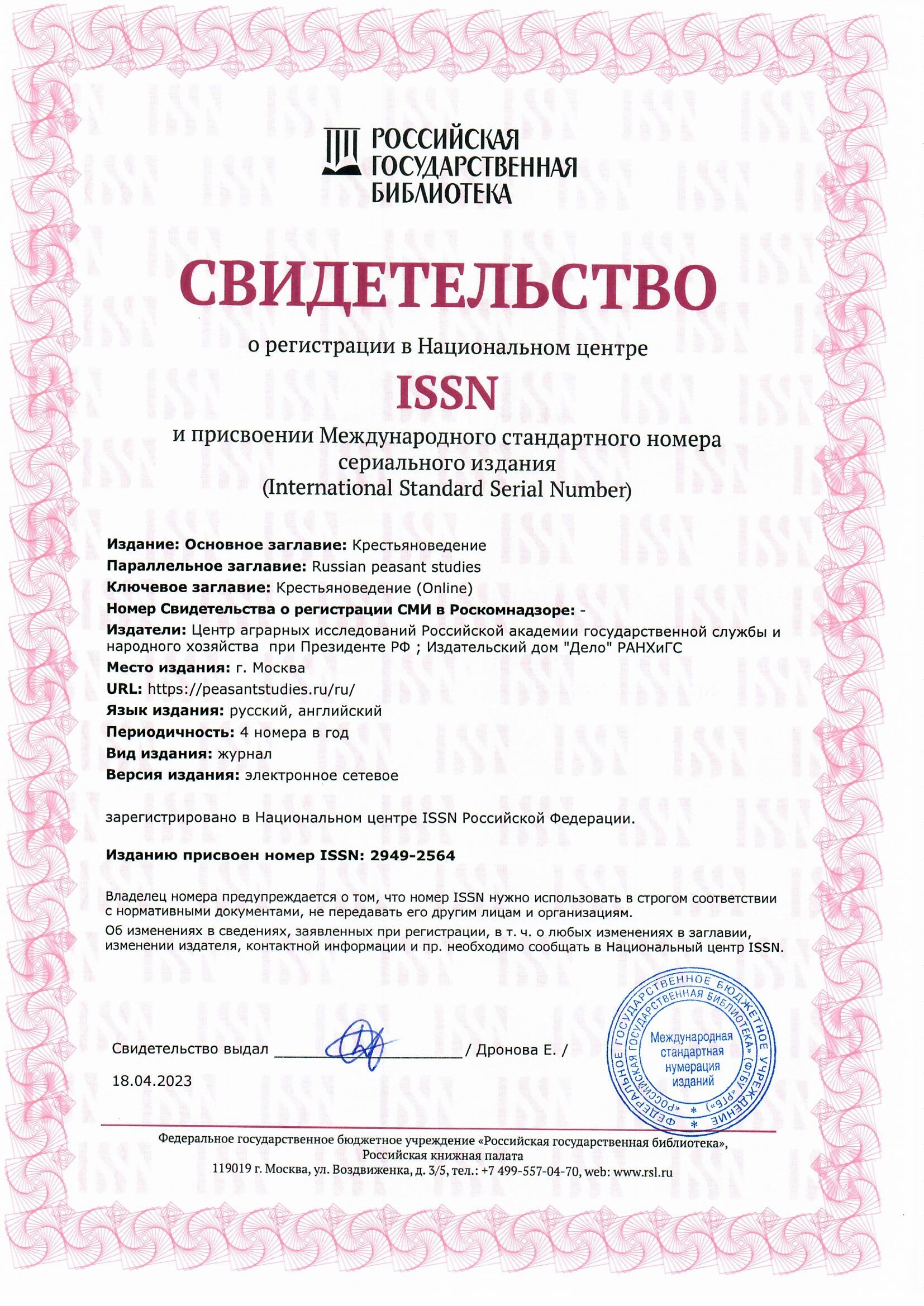
- ISSN 2500-1809 (Print), ISSN 2949-2564 (Online)
- Founded in 2016
- Frequency: four issues per year (March, Jun, September, December)
- Open Access: All volumes and articles can be downloaded for free in the PDF format.
- Author fees: free of chagre
- Indexation: Russian Science Citation Index, Russian Science Citation Index Core, List of Journals approved by Russian Hihger Attestation committee (Ministry for Sciende and Education), Scopus, UlrichWeb Global Serials Directory, European reference index for the Humanities and Social Sciences (ERIHPLUS), CNKI scholar, Sherpa Romeo , AGRIS
- Russian registration number: PI FS77-65824 27-May-2016
Hard copies of the journal can be purchased at the Delo e-store or by subscription in the "Press of Russia" Agency (subscription index - Т81017).
e-issn